Sidebar

Cluster halogenation of adamantane and its derivatives with bromine and iodine monochloride
- Details
- Hot articles
New punlications of the Institute's researchers at the journal Organic & Biomolecular Chemistry (IF 3,89)
Cluster halogenation of adamantane and its derivatives with bromine and iodine monochloride
Andrey V. Shernyukov, George E. Salnikov, Vyacheslav I. Krasnov and Alexander M. Genaev
Org. Biomol. Chem., 2022,20(43), 8515-8527, first published on 18 Oct 2022
Abstract
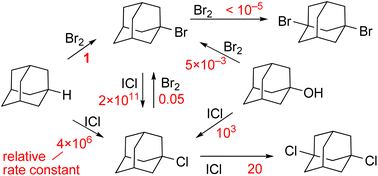
Noncatalytic halogenation of adamantane (AdH) with bromine or iodine monochloride was found to proceed according to the cluster mechanism featuring high kinetic order with respect to the halogen and a sharp decrease in the calculated energy barrier when additional halogen molecules are involved in the quantum chemical system. In the reaction with Br2, 1-AdBr formed selectively. This reaction proved to be first order in terms of AdH and approximately seventh order in Br2, and its rate does not depend on the rising concentration of HBr. It was demonstrated that the reaction of AdH with ICl is sixth order in ICl, and at the first stage, 1-AdCl forms. According to kinetic data, this reaction requires 3 equivalents of ICl. The rate of 1-AdCl chlorination leading to the 1,3-di-Cl derivative turned out to be 105 times slower than that of AdH. The halogen exchange reaction of 1-AdBr with ICl yielded 1-AdCl, and this reaction is fast and is first order in ICl. Another halogen exchange reaction, AdCl + Br2 = AdBr + BrCl, proceeded much more slowly, and the equilibrium is strongly shifted to the left (equilibrium constant: 10−6). With an excess of either Br2> or ICl, adamantanol (1-AdOH) was found to enter into a slow (compared to AdH) exchange reaction producing 1-AdBr or 1-AdCl, respectively. In all the studied reactions, ICl is ∼106-fold more active than Br2. According to DFT data, the reactions of AdH with Br2 and ICl have similar rate-limiting stages, where the H atom from AdH and X atom from polarized halogen cluster X2n> move toward each other forming an HX molecule and ion pair Ad<+X2n−1−.
Альметрики:
Метрики PlumX теперь доступны в Scopus: узнайте, как другие ученые используют ваши исследования
A study on biological properties of titanium implants coated with multisubstituted hydroxyapatite
- Details
- Hot articles
The article with participation of NIOCh's researchers is published on the site of Ceramics International (IF 5,532):
A study on biological properties of titanium implants coated with multisubstituted hydroxyapatite
Mikhail V.Khvostov, Natalia V.Bulina, Natalia A.Zhukova, Elena G.Morenkova, Denis K.Rybin, Svetlana V.Makarova, Sergey V.Leonov, Vladimir S.Gorodov, Vladimir Yu. Ulianitsky, Tatjana G.Tolstikova
Ceramics International, Available online 5 September 2022
Volume 48, Issue 23, Part A, 1 December 2022, Pages 34780-34792
https://doi.org/10.1016/j.ceramint.2022.08.067
Abstract
In this work, it was found that the composition of hydroxyapatite coatings deposited on a titanium substrate depends on the temperature of detonation products and on the composition of the initial explosive mixture. Depending on the detonation mode, it was possible to obtain a coating of oxyhydroxyapatite containing or not containing an admixture of other calcium orthophosphates. It was shown for the first time that the structure of multisubstituted Zn–Si-hydroxyapatite and Ag–Zn–Si-hydroxyapatite with substitution degree x(Zn) = x(Si) = 0.2 and x(Ag) = 0.1 has lower thermal stability as compared to unsubstituted hydroxyapatite. The formation of a small amount of the α-Ca3(PO4)2 phase upon detonation deposition of the multisubstituted hydroxyapatites was obviously due to structural transformations that occurred when the material was heated by the detonation products. In vivo biological testing of titanium implants coated or not coated with hydroxyapatite revealed that the coating significantly accelerates osteogenesis in the gap between native bone and the implant; this acceleration improved implant fixation. In animals with the uncoated plates, fibrogenesis processes significantly outstripped the osteogenesis. The presence of Zn and Si ions in the apatite coating had a potentiating influence on the osteoinduction caused by hydroxyapatite. Osteogenesis in this case was more complete and characterized by pronounced processes of mineralization of the bone plates. The addition of Ag ions to the Zn–Si-hydroxyapatite at a concentration of 1 at.% did not impair its osteogenic activity and did not have a toxic effect on bone tissue, while imparting antibacterial properties to the material.
Альметрики:
Метрики PlumX теперь доступны в Scopus: узнайте, как другие ученые используют ваши исследования

Nitrogen-Containing Heterocyclic Compounds Obtained from Monoterpenes or Their Derivatives: Synthesis and Properties
- Details
- Hot articles
The review of NIOCh's researchers is published in Journal Topics in Current Chemistry (IF 8,905)
Nitrogen-Containing Heterocyclic Compounds Obtained from Monoterpenes or Their Derivatives: Synthesis and Properties
Vladimir V. Chernyshov, Irina I. Popadyuk, Olga I. Yarovaya & Nariman F. Salakhutdinov
Top Curr Chem (Z) 380, 42 (2022),
Published 11 August 2022
Abstract
Directed transformation of available natural compounds with native biological activity is a promising area of research in organic and medicinal chemistry aimed at finding effective drug substances. The number of scientific publications devoted to the transformation of natural compounds and investigations of their pharmacological properties, in particular, monoterpenes and their nearest derivatives, increases every year. At the same time, the chemistry of nitrogen-containing heterocyclic compounds has been actively developed since the 1950s after the news that the benzimidazole core is an integral part of the structure of vitamin B12. At the time of writing this review, the data on chemical modifications of monoterpenes and their nearest derivatives leading to formation of compounds with a nitrogen-containing heterocycle core have not been summarized and systematized in terms of chemical transformations. In this review, we tried to summarize the literature data on the preparation and properties of nitrogen-containing heterocyclic compounds synthesized from monoterpenes/monoterpenoids and their nearest derivatives for the period from 2000 to 2021.
Альметрики:
Метрики PlumX теперь доступны в Scopus: узнайте, как другие ученые используют ваши исследования

Comparative Analysis of Epicuticular Lipids in Locusta migratoria and Calliptamus italicus: A Possible Role in Susceptibility to Entomopathogenic Fungi
- Details
- Hot articles
The article with participation of NIOCh's researchers is published in Journal Insects (IF 3,139)
Comparative Analysis of Epicuticular Lipids in Locusta migratoria and Calliptamus italicus: A Possible Role in Susceptibility to Entomopathogenic Fungi
Mariya D. Ganina, Maksim V. Tyurin, Ulzhalgas T. Zhumatayeva, Georgy R. Lednev, Sergey V. Morozov and Vadim Yu. Kryukov
Insects 2022, 13(8)),
Published 16 August 2022
(This article belongs to the Topic Frontiers in Chemical Ecology)
Simple Summary
The surface lipids of insects protect them from desiccation and may modulate susceptibility to fungal infections. We conducted a comparative analysis of cuticular lipids of the migratory locust and Italian locust. The former inhabits relatively wet landscapes and the latter more arid ones. We analyzed cuticular lipids of these species by gas chromatography with mass spectrometry and found that the Italian locust has a hydrocarbon profile shifted toward long chains as well as a higher content of di- and trimethyl branched hydrocarbons, which is most likely an adaptation to the arid climate and strong temperature fluctuations in its habitats. Meanwhile, the surface of the Italian locust proved to be more hospitable for fungi. The number of Metarhizium conidia attached to the Italian locust cuticle was three-fold greater as compared to the migratory locust. Mortality due to the fungal infection was faster in the Italian locust under laboratory conditions. We propose that species inhabiting arid landscapes rarely encounter fungal pathogens and primarily deal with the problem of desiccation. Therefore, they can afford a cuticle that is hospitable to fungal pathogens.
Abstract
Cuticular lipids protect insects from desiccation and may determine resistance to fungal pathogens. Nonetheless, the trade-off between these lipid functions is still poorly understood. The migratory locust Locusta migratoria and the Italian locust Calliptamus italicus have dissimilar hygrothermal preferences: L. migratoria inhabits areas near water bodies with a reed bed, and C. italicus exploits a wide range of habitats and prefers steppes and semideserts with the predominance of sagebrushes. This paper presents significant differences between these species’ nymphs in epicuticular lipid composition (according to gas chromatography with mass spectrometry) and in susceptibility to Metarhizium robertsii and Beauveria bassiana. The main differences in lipid composition are shifts to longer chain and branched hydrocarbons (di- and trimethylalkanes) in C. italicus compared to L. migratoria. C. italicus also has a slightly higher n-alkane content. Fatty acids showed low concentrations in the extracts, and L. migratoria has a wider range of fatty acids than C. italicus does. Susceptibility to M. robertsii and the number of conidia adhering to the cuticle proved to be significantly higher in C. italicus, although conidia germination percentages on epicuticular extracts did not differ between the species. We propose that the hydrocarbon composition of C. italicus may be an adaptation to a wide range of habitats including arid ones but may make the C. italicus cuticle more hospitable for fungi. View Full-Text
Альметрики:
Метрики PlumX теперь доступны в Scopus: узнайте, как другие ученые используют ваши исследования
Features of Activity of the Phenylpropanoid Biosynthesis Pathway in Melanin-Accumulating Barley Grains
- Details
- Hot articles
The article with participation of NIOCh's researchers is published onthe site of the journal Frontiers in Plant Science (IF 6,627)
Features of Activity of the Phenylpropanoid Biosynthesis Pathway in Melanin-Accumulating Barley Grains
Anastasiia Y. Glagoleva, Alexander V. Vikhorev, Nikolay A. Shmakov, Sergey V. Morozov, Elena I. Chernyak, Gennady V. Vasiliev, Natalia V. Shatskaya, Elena K. Khlestkina and Olesya Y. Shoeva
Front. Plant Sci., 11 July 2022
Sec. Plant Metabolism and Chemodiversity
https://doi.org/10.3389/fpls.2022.923717
(This article is part of the Research Topic Insights in Plant Metabolism and Chemodiversity: 2021, View all 11 Articles )
Abstract
Barley (Hordeum vulgare L.) grain pigmentation is caused by two types of phenolic compounds: anthocyanins (which are flavonoids) give a blue or purple color, and melanins (which are products of enzymatic oxidation and polymerization of phenolic compounds) give a black or brown color. Genes Ant1 and Ant2 determine the synthesis of purple anthocyanins in the grain pericarp, whereas melanins are formed under the control of the Blp1 gene in hulls and pericarp tissues. Unlike anthocyanin synthesis, melanin synthesis is poorly understood. The objective of the current work was to reveal features of the phenylpropanoid biosynthesis pathway functioning in melanin-accumulating barley grains. For this purpose, comparative transcriptomic and metabolomic analyses of three barley near-isogenic lines accumulating anthocyanins, melanins, or both in the grain, were performed. A comparative analysis of mRNA libraries constructed for three stages of spike development (booting, late milk, and early dough) showed transcriptional activation of genes encoding enzymes of the general phenylpropanoid pathway in all the lines regardless of pigmentation; however, as the spike matured, unique transcriptomic patterns associated with melanin and anthocyanin synthesis stood out. Secondary activation of transcription of the genes encoding enzymes of the general phenylpropanoid pathway together with genes of monolignol synthesis was revealed in the line accumulating only melanin. This pattern differs from the one observed in the anthocyanin-accumulating lines, where — together with the genes of general phenylpropanoid and monolignol synthesis pathways — flavonoid biosynthesis genes were found to be upregulated, with earlier activation of these genes in the line accumulating both types of pigments. These transcriptomic shifts may underlie the observed differences in concentrations of phenylpropanoid metabolites analyzed in the grain at a late developmental stage by high-performance liquid chromatography. Both melanin-accumulating lines showed an increased total level of benzoic acids. By contrast, anthocyanin-accumulating lines showed higher concentrations of flavonoids and p-coumaric and ferulic acids. A possible negative effect of melanogenesis on the total flavonoid content and a positive influence on the anthocyanin content were noted in the line accumulating both types of pigments. As a conclusion, redirection of metabolic fluxes in the phenylpropanoid biosynthesis pathway occurs when melanin is synthesized.
Альметрики:
Метрики PlumX теперь доступны в Scopus: узнайте, как другие ученые используют ваши исследования
- The Chloronium Cation [(C2H3)2Cl+] and Unsaturated C4-Carbocations with C=C and C≡C Bonds in Their Solid Salts and in Solutions: An H1/C13 NMR and Infrared Spectroscopic Study
- DFT insights into superelectrophilic activation of α,β-unsaturated nitriles and ketones in superacids
- Biotransformation of (–)-Isopulegol by Rhodococcus rhodochrous
- Intermolecular Interactions in the Crystalline Structure of Some Polyhalogenated Di- and Triamino Pyridines: Spectroscopical Perspectives