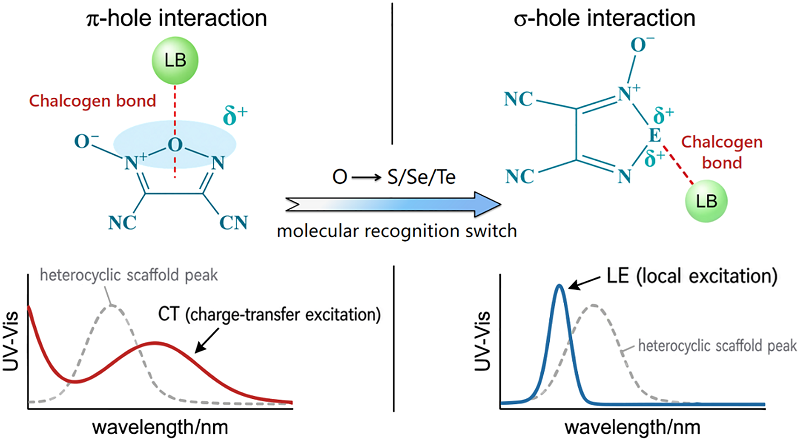
В издаваемом Royal Society of Chemistry журнале Physical Chemistry Chemical Physics (IF=3) появилась китайско-российская статья, аффилированная С НИОХ СО РАН (соавтор статьи - гнс,.д.х.н. А.В. Зибарев, лаборатория гетероциклических соединений).
В статье показано, что электростатический вклад в халькогеновуюй связь - широко изучаемую разновидность вторичных связывающих взаимодействий, может быть целенаправленно переадресован между сигма- и пи-углублениями молекулярного электростатического потенциала, в научном просторечии называемых дырами - holes (хотя, в отличие от таковых в карманах, они не сквозные). Помимо фундаментального значения, это может иметь и прикладное- в химической сенсорике.
3,4-Dicyanofuroxan and its heavier congeners: chalcogen-dependent switching between π- and σ-hole interactions in chalcogen bonding-based recognition and sensing of Lewis bases
Yue Zhang, Xinyi Zeng, Andrey V. Zibarev, Hui Wang
Phys. Chem. Chem. Phys., 2026, 28(39), 24190–24201
doi: 10.1039/d6cp02749k
Abstract
Chalcogen bonding (ChB) is promising for molecular recognition and sensing of Lewis bases (LBs). Tunable optically-detected ChB-based recognition requires understanding how the nature of the chalcogen influences both the ChB-forming interactions and the resulting optical responses. 3,4-Dicyanofuroxan (DCF) and its heavier chalcogen congeners (E–DCF; E = S, Se, Te) are studied with molecular electrostatic potential, density functional theory, its time-dependent incarnation, quantum theory of atoms in molecules, and hole–electron analysis as suitable recognition and sensing platforms. All compounds feature electrostatic π-holes. Unlike E–DCF with two non-equivalent σ-holes, DCF exhibits only one hole. In ChB-based LB recognition and sensing, DCF acts as a π-hole donor, while with E–DCF the recognition is switched to σ-hole interactions, which results in a distinct optical response. DCF selectively produces charge-transfer (CT) excitations in the case of halide anions, generating pronounced red shifts in electronic absorption spectra in the UV-vis region. In contrast, E–DCF mainly preserves locally excited (LE) character, producing intensity modulation and moderate spectral band shifts. Highly polarizable [I]− breaks the trend, inducing strong CT character in the case of [S–DCF⋯I]− and mixed CT/LE character in the case of [Se–DCF⋯I]−, demonstrating that the polarizability can overcome chalcogen-dependent orbital constraints. The chalcogen contribution to the holes’ spatial distributions positively correlates with spectral red shifts, linking excited-state structure to optical selectivity. Together with solvent-dependent differences, these findings demonstrate that the ChB-based interactions of E–DCF (E = O, S, Se, Te) with LBs are π-hole ↔ σ-hole switchable, providing theoretical guidance for their potential applications in tunable molecular recognition and sensing responses.
Visual Abstract