В журнале ChemistryOpen (IF=3,1) по результатам работы, выполненной совместно с коллегами из Института химической кинетики и горения СО РАН, Томографического центра СО РАН, Новосибирского государственного университета, учёных из Испании (Universitat de Barcelona), Швейцарии (University of Bern, Bern) , опубликована статья, соавторами которой является сотрудники Института: мнс А.А. Буравлев (аспирант) , д.х.н., внс А.Ю. Макаров, к.х.н., снс И.К. Шундрина, к.х.н., снс И.Г. Иртегова, д.х.н., внс И.Ю. Багрянская, д.х.н., завлаб ЛЭАСМ Л.А. Шундрин, д.х.н., гнс А.В. Зибарев:
Stable 1,3,2-Benzodithiazolyl Radicals: Modification of Reactivity, Crystal Packing, and Solid State Magnetic Properties by Fluorination
Alexander A. Buravlev, Alexander Yu. Makarov, Jordi Ribas-Ariño, M. Àngels Carvajal, Mercè Deumal, Yaser Balmohammadi, Simon Grabowsky, Inna K. Shundrina, Boris A. Zakharov, Irina G. Irtegova, Mikhail N. Uvarov, Artem S. Bogomyakov, Irina Yu. Bagryanskaya, Leonid A. Shundrin, Andrey V. Zibarev
ChemistryOpen, Volume15, Issue3, March 2026, e202500561
First Published: 26 February 2026
https://doi.org/10.1002/open.202500561
Статья посвящена химии и физике новых стабильных пи-радикалов - синтезированных в НИОХ фторированных 1,3,2-бензодитиазолилов. Найдены очень необычные химические реакции, перспективные для дальнейшего применения. Около комнатной температуры некоторые радикалы обладают гистерезисной магнитной бистабильностью, т. е. являются прототипами магнитно-активных функциональных органических материалов - очень горячая тема сейчас. Магнитная бистабильность и гистерезис около комнатной температуры зависят от степени фторирования радикалов. Объяснено, почему это так. Показано, что для материаловедения наиболее перспективны мало фторированные радикалы, которые сейчас интенсивно изучаются этой же международной авторской группой.
Abstract
Impact of fluorination on crystal and molecular structure, heteroatom reactivity, and solid-state magnetic properties of thermally-stable π-radicals is studied experimentally and computationally with 1,3,2-benzodithiazolyl 1· and its 4,7-difluoro, 4,5,6,7-tetrafluoro, and 4,7-difluoro-5,6-(hexafluoropropane-1,3-diyl) derivatives 2·-4·, respectively. Radicals 2·-4· are isolated by vacuum thermolysis of their unusual covalent 2:1 adducts with 7,7,8,8-tetracyanoquinodimethane. The impact of fluorination on reactivity is evidenced by transformation of 2·-4· and 2+-4+ into corresponding 2H-1-oxo-1,3,2-benzodithiazoles under the influence of air's or solvents’ moisture; back transformation into the cations under the action of protic acids; and formation of a paramagnetic molecular complex between 3· and naphthalene, whereas 1· and octafluoronaphthalene do not exhibit complexation. The crystal structures of 3· and 4· reveal a novel packing motif featuring radical pairs linked by four-center interactions that stack into offset π-columns, forming a unique zip-π-stack synthon that incorporates head-over-tail π-pairs of radicals. Despite the formation of π-pairs, polycrystalline 3· and 4· display a nonzero effective magnetic moment that rises with temperature above 200 K, although the values remain significantly lower than those of the high-temperature polymorphs of magnetically-bistable 1· and 2·. This behavior can be rationalized by different magnetic topologies and values of spin exchange between the radicals.
Graphical Abstract
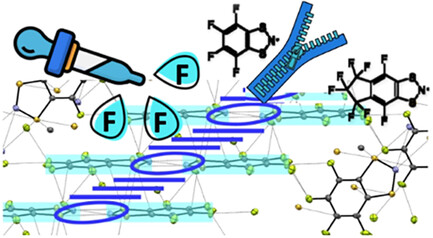
Fluorination reduces solid-state thermal stability of 1,3,2-benzodithiazolyl radicals and modulates crystal structures (e.g., by means of a new supramolecular zip-synthon) and reactivity, in the latter case toward transformations unknown in the hydrocarbon series but potentially general in the fluorocarbon one. Low fluorination is favorable and high fluorination is unfavorable for hysteretic magnetic bistability of the radicals around room temperature.